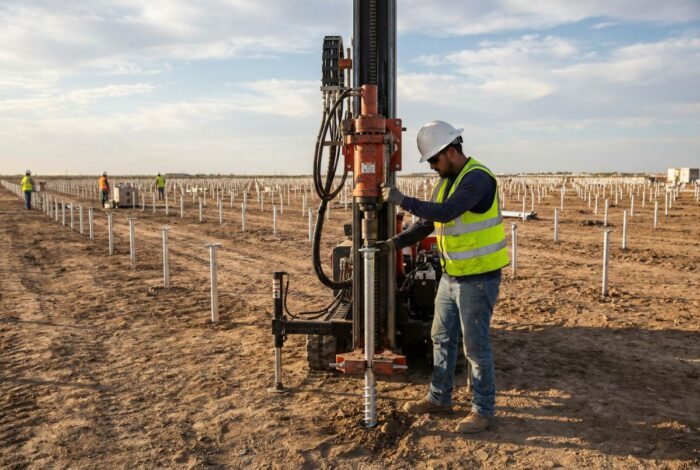
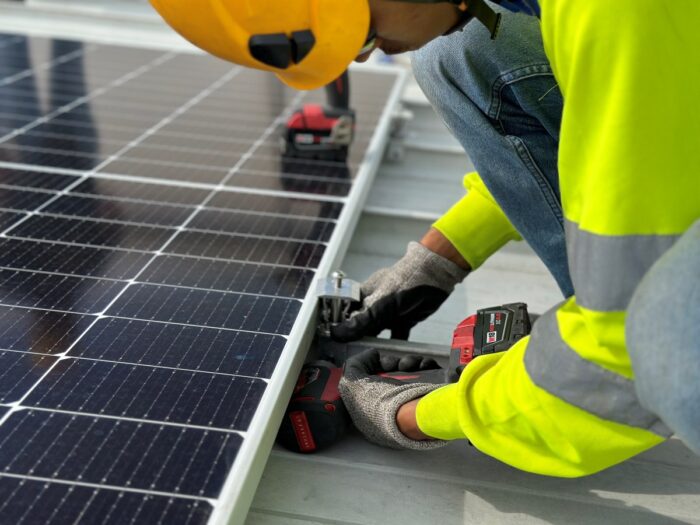
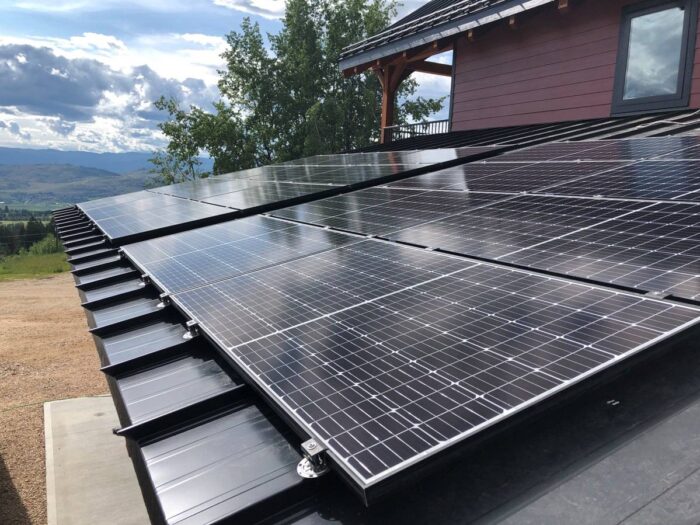
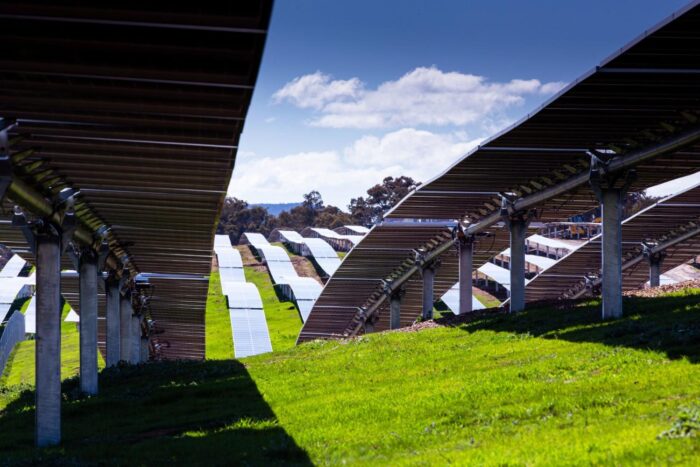
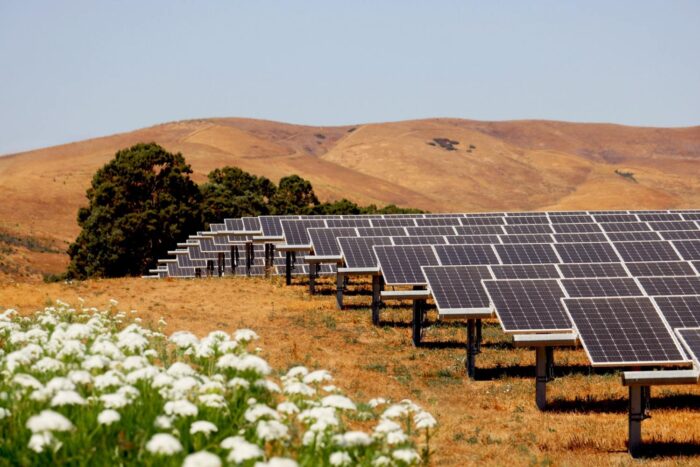
“Terrasmart was one of the first providers of ground screw foundations in the U.S., bringing additional reliability and performance to sites in challenging conditions and opening new opportunities for ground-mount solar,” says Ed McKiernan, President, Terrasmart. “Moving domestic ground screw production in-house streamlines our supply chain, maximizing availability for qualifying solar projects to meet domestic content thresholds to benefit our customers, the solar industry, and the wider U.S. economy.”
Ground screw manufacturing expansion
Currently, Terrasmart’s ground screw manufacturing capacity is on track to sustain nearly 500 MWs of new PV projects.
To make this possible, the new production line consists of twelve work stations, an induction heater, forge, plasma cutter, stamping press, three-hole punch and set nut welder, and six helical welders. The facility will also add three different sizes of ground screws to its list. To empower its team members, Terrasmart trained and upskilled the ground screw assembly line team in five new skill sets.
Ground screws for tough terrains
Ground screws are a crucial type of solar foundation because they are more effective in tougher terrains and in a wide variety of soils, in addition to the driven piles and ballasted foundations that make up Terrasmart’s foundation portfolio.
“We are known for our focus on advising on and providing the optimal foundation solutions for every site. Domestic, in-house ground screw production allows us to partner with our customers with even greater efficiency and reliability,” explains Yury Reznikov, Chief Sales Officer, Terrasmart.
Domestic content impact
Supply chain resilience has been top of mind for solar industry professionals amidst disruptions rippling from ongoing changes and pressures in global trade and logistics. This expanded in-house production adds to Terrasmart’s on-shoring of its supply chain, which is part of Terrasmart’s larger vertical integration strategy. Vertical integration enhances supply chain resilience and maximizes availability for domestic racking components.
Example of soil and erosion challenges on a solar site. Photo credit JPH Enterprises
Utility-scale solar sites go through years of planning to secure the right land, permits and partners. But one critical factor is still too often overlooked in the early development stages: the soil. According to GIS-backed research from Profile Products, an agronomic solutions company, nearly half of solar projects face an increased risk for soil health issues and nearly one third are at-risk for increased erosion, which can lead to environmental issues, project delays and fines.
To address these challenges, more project teams are embracing early collaboration among all stakeholders through the “three Ps” of planning: prediction, prevention, and prescription. By predicting environmental risks like erosion or poor soil health using GIS modeling, preventing those risks through informed design, and prescribing site-specific best management practices, developers and EPCs are building projects that perform better.
With this approach, many solar sites are producing better environmental outcomes, experience fewer regulatory setbacks and deliver cost-effective solutions.
Prediction: Understand the risks before they become problems
Erosion issues and soil health challenges can be difficult to diagnose on a site because they often remain invisible until construction is underway. At that point, it can be too late. But with predictive modeling and soil testing, these issues come into focus.
To better understand what’s going on in the soil, workers will gather soil samples and evaluate conditions to develop successful vegetation management plans. Photo credit: James Hartsig
“It takes an all-hands-on-deck approach,” said James Hartsig, director of vegetation management at a global developer, owner and operator of clean energy solutions. “Early on in each solar project, we discuss, ‘What are the potential risks associated with these buildable areas?’”
Hartsig’s nine-person vegetation management team works with soil scientists, botanists, engineers and consultants to assess everything from topsoil depth to invasive species. On recent projects, Hartsig’s team has used GIS-based modeling platforms to map erosion and soil heath risk. One program, PV-IMPACTS (Integrated Mitigation Program for Assessment of Climate, Topography and Soils), assesses factors like rainfall erosivity, soil erodibility, slope gradient and organic matter content alongside additional regulatory and interrelated environmental inputs. It then creates custom-built erosion and soil health risk indexes to help developers make informed decisions.
“We’ve used GIS-based modeling programs to evaluate some of our more challenging sites in the arid West,” Hartsig said. “It gives us critical information on a micro-scale so we can pinpoint more accurate revegetation practices.”
An example of a soil health assessment report developed from GIS-modeling. Photo credit: Profile Products
Environmental contractors like John Henry, president of JPH Enterprises, are often called in to fix problems. But Henry says the most successful projects are the ones where he’s involved from the beginning.
“Getting the data from that system in the early stages is a huge benefit to the industry. That will show you where your critical areas are,” Henry said. “Then you need to consult with an environmental contractor through the design phase. Often the focus is on the cost of the megawatt, or the electrical components, and they lose sight of the environmental scope and the costly implications that can come from it.”
Prevention: Creating an informed design
With the data collected during the prediction stage, stakeholders assess the issues and develop a preventive solution. Ideally, EPCs, developers and environmental contractors are all pulled into the design conversations, not just construction meetings.
“We try to get in as early as we can to offer as many ideas as we can. Sometimes we just aren’t given the opportunity,” said Henry. “We really try to stress that we’re going to give everybody a better project at a better cost if we can get in early and help establish the project. Because we have the civil knowledge.”
Hartsig said in the last few years, there’s been a shift to bring collaborators in to help during that design phase, and it’s proven to be the right strategy. Based on the information gathered in the prediction phase, Hartsig can then work with stakeholders to build a vegetation and soil management plan.
“We discuss this with our internal engineers, our external engineers, and we bring our EPCs into these conversations,” said Hartsig. “But we also involve erosion control experts so we can have a knowledgeable understanding of what’s going on in these areas. We regularly encourage our vegetation contractors, who have the equipment and expertise to plant seed on disturbed land, to be included on these projects to streamline vegetation objectives.”
Prescription: Implementing the Right Solution
The final step is prescription — employing the best management practices and customized product solutions that will establish long-term, sustainable vegetation utilizing the prediction phase and the informed design produced during prevention. If stakeholders can collaborate on selecting the right solutions, it doesn’t just lead to better environmental outcomes, it can also provide cost, labor and time savings.
“There are incredible resources available for solar developers to use when planning how to establish desired vegetation on these types of projects,” said Hartsig. “Whether those resources are with companies that can provide the most successful soil amendments and fertilizers or with vegetation contractors and their access to the equipment needed to implement those plans, vegetation objectives can be achieved when planning for success.”
Hydraulically applied erosion control products are applied in a slurry that bonds to the soil. Photo credit: Profile Products
One of the most effective methods to establish sustainable vegetation is hydroseeding, a practice that involves applying a slurry of seeds, mulch, water and soil-enhancing technologies over large areas to temporarily stabilize the soil, improve soil health and promote rapid vegetation growth.
Hydroseeding allows for workers to easily maneuver between panels to apply proper soil amendments and erosion control products, like on this old coal mining site that was transformed into a solar project in the Northeast. Photo Credit: JPH Enterprises
Henry explained how hydroseeding was used on a recent solar site in the Northeast that was built on an old coal mine. The site had very little topsoil, if any, and the cost to import would have put the project far over budget. Instead, he recommended a hydraulically applied biotic soil media plus erosion control product to ignite the nutrient cycling necessary to improve the soil health while locking down the seed and soil.
“Getting vegetation established in that area is very complicated,” he said. “But for having hardly any soil on this site, we got really good results when we hydroseeded with this all-in-one biotic soil and erosion control product.”
Early collaboration, lasting impact
When developers, EPCs and environmental contractors work together from day one, they’re able to build a successful site that meets regulatory compliance while being cost-effective.
Lush vegetation on a solar site in Texas. Photo credit: James Hartsig
“We’ve worked closely with regulators across the country on our approach, and we’ve seen them support our methods,” Hartsig said. “These practices have shown to be very cost efficient with the amount of remedial seeding being reduced and the frequency of maintenance activities and operations being decreased.”
Alongside the environmental and financial benefits, Hartsig’s team has found that implementing the right vegetation management plan with informed decisions from all stakeholders has helped earn community trust.
“We’re demonstrating to communities and to landowners that we really care about land stewardship,” Hartsig said. “Our ultimate goal is to make sure that we are carrying out the community’s mission to keep their lands and soils fertile so that when the project is decommissioned, those fields will be even more productive for future generations.”
By engaging the right expertise from day one to develop predictive, preventative and prescriptive plans, solar project teams are showing that clean energy development can deliver long-term environmental and cost benefits.
Stephen MacShane is a market development manager at Profile Products.
Solar racking manufacturer OMCO Solar, which has built its brand on shipping factory-direct solar trackers and fixed-tilt solutions, is now offering a 100% U.S.-made solar tracker system. With the delivery of Kinematics’ American-made drives and motors, OMCO’s fully domestic tracker solution is officially being deployed to project sites nationwide.
OMCO Solar is the solar division of OMCO Holdings, which has more than 70 years of American manufacturing experience, and has manufactured components for solar systems for decades. Its vertically integrated model has helped them deliver solar mounting / racking / tracking systems with short lead times. Offering a 100% domestic product further adds to its position in the market, and keeps the OMCO tracker tariff-free.
“OMCO has historically been a leader in solar domestic manufacturing and this achievement, working in conjunction with our partners at Kinematics, is a milestone for our team,” says Eric Goodwin, VP of Business Development. “The timing of this also allows OMCO Solar’s Phoenix, AZ Headquarters, one of five OMCO manufacturing plants in the US. OMCO to deliver for our customers immediately in the aftermath of the OBBB passage and the compressed schedule requirements to ensure tax credits for projects are secured.”
Combining the OMCO U.S. manufacturing footprint (five plants) with Kinematics’ U.S. volume adds up to 13 GW annual capacity.
“At Kinematics, we are proud to support our solar tracker partners like OMCO Solar with actuators, motors, and controllers that qualify for U.S. domestic content,” said Jenn Cangelosi, Vice President of Global Sales at Kinematics. “With three manufacturing facilities in the United States, three additional factories around the world, and a team of over 800 employees globally, we’re uniquely equipped to deliver high-performance motion solutions at scale. With more than 135 gigawatts of fielded systems, our technology is trusted by the world’s leading solar innovators.”
“Everything we make, we make in the US – with US drives and motors, we can now ship all-US tracker solutions,” says Matt Kesler, Director of Solar Technology.
To date, OMCO Solar has delivered over 12 GW of factory-direct solar mounting structures within the US.
S-5! announced a new distribution partnership with Krannich Solar USA, a division of the global solar distributor, Krannich Solar. As an authorized distributor, Krannich Solar USA will offer the full line of S-5! solar mounting solutions across their four U.S. branch locations.
“Krannich has been a valued supporter of S-5! for many years,” said Rob Haddock, S-5! Founder and CEO. “This official distribution agreement is the culmination of a long-standing, collaborative relationship between our teams. We look forward to expanding our reach and making S-5! products more accessible than ever through Krannich’s nationwide presence.”
Headquartered in Germany, Krannich Solar operates in over 30 countries, serving residential, commercial and utility-scale solar installers and EPCs with a broad range of solar photovoltaic products, including modules, inverters, racking systems and balance-of-system components.
“We are excited to partner with S-5!, a company whose commitment to innovation and quality aligns seamlessly with our own values,” said Ean Kyler, CEO of Krannich Solar USA. “S-5!’s proven track record in delivering reliable, efficient roof attachment solutions makes them an ideal partner. We share a commitment to sustainability, engineering excellence and exceptional customer service, and we’re confident that this collaboration will drive forward the adoption of solar energy across key markets.”
Kyler also noted that S-5!’s high-volume, automated manufacturing processes at its ISO 9001:2015-certified facility ensure consistent product quality, affordability, and availability. “Their products are engineered to last the life of the roof—and that’s exactly the reliability our customers expect,” he added.
S-5! metal roof expertise
Solar panels make a great pair with metal rooftops – as long as you have the right attachment system and support team that understands the nuances of the application. Today on the Pitch we’re talking all about solar mounting on metal roofs with Jesse Winternitz, application engineer with S-5!
0:34 – Background of S-5! and metal roof attachment
Solar tracker structures that can be mounted to “follow” the natural topography of a site can be a crucial factor in the technical and financial viability of a solar project development. A solar tracker with higher slope tolerances means a greater degree of adaptability in PV project sites with complex or irregular terrains, and a reduction in the amount of grading needed to make a site viable.
PV Hardware (PVH) announced a new technical advancement that allows tracker installations to adapt to up to 2 degrees post-to-post versus the more typical standard of 1.5 to 1.75 degrees. “By increasing the slope tolerance, we offer our clients greater design flexibility and the ability to build in locations previously considered too challenging or costly,” stated Eduardo Chillaron, Global Technical Manager of PVH.
This upgraded feature is now fully integrated into PVH’s latest generation of tracking systems and is already being implemented across multiple global projects in development.
The value of 2 degrees
The ability to accommodate up to 2 degrees of post-to-post variation brings immediate benefits in both engineering and environmental terms. Earthworks during site preparation can be reduced by up to 90 percent, according to PVH. This is particularly relevant in agrivoltaic projects, where maintaining the integrity of the land is essential for future agricultural use and biodiversity recovery.
Beyond environmental gains, the increased tolerance significantly improves installation efficiency. The design allows for shorter piles—up to 0.7 meters less in length—and shallower ramming depths, while also simplifying logistics and alignment procedures on-site. Together, these improvements boost PVH tracker installation timelines by over 40 percent.
Solar tracker foundations
We’ve discussed solar tracker hardware innovations a lot the last few years. On The Pitch, Sol Hutson and Charles Almy from Nextracker dig deeper on the importance of solar tracker foundations:
What role do foundations play in executing a terrain following tracker design?
Almy: “We’re kind of expanding the definition of what terrain following means to include topographic but also geotechnical conditions. Reveal window is something really important to the project engineers of EPCs. That is: how much variation can you have on your H piles, or basically the torque tube height above ground at any location. With H piles, you have a very narrow reveal window. With any sort of anchor system, where you have a a triangle — whether it be an anchor or the Ojjo solution — you get penalized a lot less for going high. We have a much bigger reveal window, which allows us to go over things that we previously couldn’t.”
Hutson: “Along a row, you may have only a 5-ft-wide section that is a wash and you need to place a pile there in order to maintain your tracker row. And to build on BLM land, there oftentimes are requirements to not cut and fill, and to leave those washes as they are. So even a terrain-following tracker may not be sufficient to be able to manage that very narrow deep and steep wash situation, where the Ojo solution as an example certainly can.”
On this episode, Chase Anderson, director of platform engineering for Terrasmart, explains the latest innovations in solar trackers, ground screws, wind tunnel testing, and solar project site planning:
Is it fair to say this is more process innovation than product innovation?
Anderson: “Very early on in the process we will do what’s called a slope analysis. We essentially use the same leg algorithm right up front when a customer provides topo so that we have the best understanding of what we’re getting ourselves into and can plan for that.
“Our products are all designed to be highly configurable, so by doing that advanced slope analysis up front, we can select the right configuration and make sure the right pieces and parts are getting to the site.
“There are things in the product that do make it unique, especially on the ground screw side. The ground screw tolerance is at grade whereas a driven pile is at the top of the pile, which could be four, five, six feet in the air. The result that we have to build the tolerances and the adjustability differently for ground screws than we do for piles.
“The other piece is the telescoping leg that we have in the ground screw is just incredibly powerful at dealing with these terrain issues. So, it’s really a mix of both, and they work together.”
The 100% domestic content solar tracker market is filling up. Since Nextracker claimed the “first” in December 2024, several other tracker manufacturers have filled the final supply chain gaps—sourcing actuators, drives, and controllers domestically—to launch their own 100% domestic content solar tracker solutions. Others are also promoting safe harbor strategies in preparation for the upcoming change to “construction start” language. Here’s a recap of recent announcements.
Domestic Content Table for Ground-Mount Trackers
For reference, here is a breakdown of the “First Updated Elective Safe Harbor” domestic content percentages from Treasury Notice 2025-08 for Ground-Mount Trackers, modified Notice 2024-41. The column on the right is that original New Elective Safe Harbor for comparison’s sake.
“OMCO has historically been a leader in solar domestic manufacturing and this achievement, working in conjunction with our partners at Kinematics, is a milestone for our team,” says Eric Goodwin, VP of Business Development. “The timing of this also allows OMCO Solar’s Phoenix, AZ Headquarters, one of five OMCO manufacturing plants in the US. OMCO to deliver for our customers immediately in the aftermath of the OBBB passage and the compressed schedule requirements to ensure tax credits for projects are secured.”
OMCO Solar is the solar division of OMCO Holdings, which has more than 70 years of American manufacturing experience, and has manufactured components for solar systems for decades. Combining the OMCO U.S. manufacturing footprint (five plants) with Kinematics’ U.S. volume adds up to 13 GW annual capacity. To date, OMCO Solar has delivered over 12 GW of factory-direct solar mounting structures within the US.
“Moving domestic ground screw production in-house streamlines our supply chain, maximizing availability for qualifying solar projects to meet domestic content thresholds to benefit our customers, the solar industry, and the wider U.S. economy,” says Ed McKiernan, President, Terrasmart.
Currently, Terrasmart’s ground screw manufacturing capacity is on track to sustain nearly 500 MWs of new PV projects. The new production line consists of twelve work stations, an induction heater, forge, plasma cutter, stamping press, three-hole punch and set nut welder, and six helical welders. The facility will also add three different sizes of ground screws to its list. To empower its team members, Terrasmart trained and upskilled the ground screw assembly line team in five new skill sets.
Nextracker solidifies 100% domestic content to start 2025
As mentioned, back in December 2024, Nextracker announced it shipped and delivered what they believed to be “the first U.S.-manufactured solar trackers expected to achieve 100% domestic content value.” These were delivered to SB Energy’s Pelican’s Jaw project, 570 MW solar and 954 MWh storage project under construction by SOLV Energy.
Together with its manufacturing partners, Nextracker has now expanded or opened more than 25 U.S. factories with over 30 GW of annual capacity.
“By systematically focusing our manufacturing partnerships close to our customer project sites, we secure the supply chain and provide superior on-time delivery and cost savings for project development and construction,” stated Dan Shugar, Nextracker founder and CEO. “We also significantly de-carbonize our products by incorporating clean steel manufactured in the United States.”
ARRAY set to deliver 100% domestic content trackers to Indiana project
The 200 MWac Emerald Green Solar project in Indiana being developed by ENGIE North America (ENGIE) will be with a domestic content ARRAY OmniTrack tracker. Deliveries of the trackers are expected to begin in Q3 2025.
ARRAY Technologies says the trackers meet 100% of the domestic content Assigned Cost Percentage (ACP) under the U.S. Treasury Department’s latest guidance (Notice 2025-08) issued in January 2025. To validate full compliance with federal guidelines, ARRAY partnered with a third-party tax and advisory firm to analyze its manufacturing processes and supply chain. It enables developers to qualify for the maximum 28.7% ACP, which includes the 9.4% production ACP available exclusively for projects using trackers with only domestic content manufactured product components.
“The fact that the steel used in ENGIE’s largest energy project in Indiana will include torque tube and steel rolled locally in the state and installed by some of the more than 250 construction workers that will build the project really reflects the local nature of renewable energy production in the U.S.” said David Carroll, Chief Renewables Officer and Senior Vice President at ENGIE North America
GameChange and FTC promote module-agnostic safe harbor strategies
Following the passage of the OBBB, the upcoming changes to the definition of “construction start” will have a big impact on tax credit eligibility. Both GameChange Solar and FTC Solar are emphasizing the importance of designing projects with module flexibility to accommodate potential future module changes, and thus promoting their torque tubes.
GameChange Solar’s Genius Tracker system has unpunched torque tubes, low-profile bearings, and SpeedClamps or flexible purlins to accommodate changes in module dimensions or mounting hole patterns without requiring costly field rework. In addition, in January, GameChange Solar, announced six more tracker torque tube factory partners across the United States, with a combined annual production capacity exceeding 35 GW.
FTC Solar’s 1P “Pioneer” trackers utilize universal torque tubes with innovative Python Clip rail designs, which eliminate the need to puncture torque tubes and accommodate any variation in module form factor, giving developers and EPCs ultimate flexibility for module changes late in the design process.
“FTC Solar’s products are not just safe harbor eligible – they are optimized for safe harbor,” said Yann Brandt, CEO of FTC Solar. “Whether developers pursue a hard money investment or an early works construction start, FTC Solar is ready to support with proven tracker technology, engineering expertise, and domestic capacity.”
In terms of 100% domestic content tracker, FTC Solar says it is rapidly scaling a domestic supply chain, and will begin taking orders starting in Q4 2025.
A staggering 80% of solar projects never reach completion. But you can speed up timelines by as much as 50% by using the right software during the design stage.
On this episode of The Pitch, Hector Lucas Foraste, Solutions Engineer with PVcase, explains the bottlenecks in solar project development and then gives an overview of the end-to-end solar design and project development product suite offered by PVcase. You can watch the Pitch episode above, or watch this on-demand webinar for a deeper demonstration, and to send questions directly to the PVcase team.
Solving common bottlenecks in solar project development
“We see that there are a lot of issues when we are sharing information from one point to the other one, or when we are working with different team members or stakeholders.,” Hector says.
Traditional platforms and workflows among stakeholders often contribute to lengthening the timeline with this inefficient back and forth.
“It is very common to have different tools throughout the whole workflow. This brings many issues when those tools are not well connected in the end. And this is what we are trying to do,” Hector says. “What we are showcasing today … PVcase has done this in an efficient way. It allows us to run the process from developing a project up to the detailed engineering, jumping from one stage to the other one without any issues.”
PVcase overview
PVcase is automating the entire solar development value chain. Their end-to-end suite — Prospect, Ground Mount, Roof Mount, and Yield — provides automation software for site selection, PV design, and yield assessment. PVcase offers an alternative to manual methods and delivers optimal results in significantly less time.
What’s new? Launched in response to user feedback, PVcase has rolled out comprehensive updates across its end-to-end solar project development platform, significantly enhancing workflow automation and accelerating project development.
PVcase Prospect accelerates site selection with bulk parcel import, integrated fiber/zoning data, GIS integration, Capacity data, automated multi-parcel layouts with DC estimates, and instant federal environmental permit checks.
PVcase Ground Mount features optimized layouts (fixed-tilt/east-west) with improved 3D terrain-aware shading calculations and structural gap control. Its enhanced electrical overview includes more metrics, NEC-compliant voltage drop calculations, and better DC cabling configuration, alongside improved LandXML export and web viewer access.
PVcase Yield introduces a company-level component library, crucial CdTe thin-film module simulation support for accurate predictions, updated inverter temperature derating models, and improved export functionality.
PVcase Roof Mount boosts efficiency via multiple integrations, PVsol project conversion, user-managed component libraries (including inverter presets), and enhanced stringing intelligence—from assignment to polarity and tolerance adjustments. It also now supports energy simulations with mixed module orientations.
Applications open through November 1 for trade school, college, and university students pursuing careers in construction and renewable energy
A $1,500 scholarship could soon help a future solar installer, roofer, or project manager get their start. Metal roof attachment manufacturer S-5! has announced a new scholarship program aimed at students pursuing construction- and solar-related education at trade schools, community colleges, or universities.
The focus on workforce development is not new for S-5!. Last year they teamed with the National Women in Roofing (NWIR) on a new scholarship program to empower women who wish to pursue educational opportunities in the skilled trades, including solar installations. They also sponsored the Let’s Build Construction Careers (LBCC INC) camp for girls in Canfield, Ohio.
This new scholarship program is designed to encourage students entering a broad range of fields tied to the built environment — from engineering and design to skilled trades and solar installation. Applications are due November 1, 2025.
Building the workforce pipeline
The scholarship will award $1,500 to one student who demonstrates a commitment to careers in construction and renewable energy. Applicants must submit an online application, provide two letters of recommendation, and maintain communication with S-5! if selected.
“Supporting the education of future construction professionals aligns with our mission to lead, serve and give back to the industry that has shaped us,” said Rob Haddock, founder and CEO of S-5!. “This scholarship is an extension of our belief that knowledge and opportunity drive progress in construction and solar.”
Industry context
Workforce development has become a consistent theme across the U.S. solar and construction industries. Labor shortages and a growing demand for skilled installers, engineers, and tradespeople continue to challenge project timelines and costs. By creating a scholarship program, S-5! joins other industry players in investing directly in the next generation of workers.
Founded in 1992, S-5! is best known for its zero-penetration metal roof clamps and brackets, which are installed on more than 3 million roofs worldwide and have supported more than 9 GW of roof-mounted solar. The Colorado Springs–based company says the new scholarship aligns with its broader vision of contributing to industry growth through education, leadership, and service.
“We are excited to launch this program and help build a strong pipeline of talent,” Haddock added.
How to apply
Applications are open now and will be reviewed by the S-5! Scholarship Committee. Students interested in applying can learn more and access the application portal here: S-5! Scholarship Program 2025.
New controller for Origin single-axis trackers promises faster commissioning, fewer gateways, and under-3-minute battery swaps; built in OMCO’s U.S. factories with domestic content
OMCO Solar is adding its own brain to its factory-direct trackers. The company today introduced the OMCO Star tracker control system, a wireless controller designed to pair with OMCO’s Origin single-axis trackers and reduce commissioning time and total cost of ownership.
As we’ve written previously, the change is networking: Star uses LoRa long-range wireless with site communication distances of more than a mile, which can shrink the number of network controllers or gateways needed on large sites. Fewer devices means fewer terminations and less troubleshooting, and it simplifies site expansion phases.
What’s new and why it matters
Field-replaceable battery in under three minutes for quick maintenance turnarounds.
Direct communication to many devices with fewer gateways required, leveraging LoRa’s long-range, low-power profile.
Advanced weather features designed to respond to wind, hail, snow, overcast conditions, and flooding.
DC-only controls, eliminating AC runs, conduit, and trenching at the row level.
“The launch of the OMCO Star Tracker Control System is the culmination of years of collaboration by our engineering and in-house software teams, alongside valuable feedback from customers, installers, and partners,” said Lepolve Varpilah, director of electrical and software engineering. “We are proud of the results — a solution that redefines how single-axis trackers perform in the field.”
Factory-direct angle and availability
Star is manufactured in OMCO Solar’s U.S. facilities and ships with the company’s Origin factory-direct trackers. OMCO cites its domestic manufacturing footprint and direct access to engineering as drivers for shorter lead times and on-time shipments, along with full domestic content options. The company notes a 70-plus-year steel manufacturing history and more than 12 GW of mounting structures delivered within the United States.
“Through its factory-direct model, OMCO Solar delivers the industry’s shortest lead times, on-time shipments every time, complete domestic content, and direct access to engineering, manufacturing, and support teams,” said Gary Schuster, OMCO’s president and CEO. “The addition of the OMCO Star Tracker Control System demonstrates OMCO Solar’s dedication to continuous innovation and product development that meets the evolving needs of the solar industry.”
Rail-less mounting system certified for hurricane zones as company highlights new canopy applications at RE+ 2025
Florida’s hurricane codes are some of the toughest in the country. At RE+ 2025 in Las Vegas, S-5! announced that its PVKIT solar mounting system has earned Florida Product Approval (FPA) for use in High-Velocity Hurricane Zones (HVHZ)—making it the first metal roof attachment manufacturer to achieve the certification.
Backed by more than 5,000 load tests across all major roof profiles, materials, and gauges, the FPA designation simplifies code compliance and permitting for installers working in Florida’s high-wind regions. The certification gives contractors, inspectors, and designers added assurance that PVKIT can withstand extreme conditions.
S-5! is also showcased a new solar carport application, bringing its metal roof mounting technology to purlin-framed canopy structures. As you see in the picture, the S-5! solution doesn’t penetrate. The company says the approach provides watertight connections, strong wind uplift resistance, and fast installation with fewer components. The solution is compatible with most Cee and Zee purlin designs and maintains compliance with UL 2703, UL 3741, FPA, and FM Approvals.
“Carports are becoming a bigger piece of the distributed solar landscape, and they bring unique structural challenges,” said the company in its announcement. “By applying our proven roof attachment expertise to canopies, we’re giving contractors a simpler, hurricane-tested solution for these projects.”
The PVKIT remains S-5!’s flagship product and one of the most widely used rail-less solar mounting systems in the industry. By integrating carport applications and earning hurricane-zone certification, the company is positioning the product line as a versatile option for both rooftops and canopy-style solar structures.
“Our team continues to innovate and adapt our technologies to serve evolving solar applications—including carports,” said Rob Haddock, CEO and founder of S-5! “And with our PVKIT now Florida Product Approved for HVHZ, our partners can trust it to perform even in the most extreme conditions.”
From OMCO Solar’s new long-range STAR controller to Nextracker’s steel frame acquisition, tracker makers are refining their hardware and broadening their reach ahead of 2026
OMCO Solar’s new OMCO Star Controller. Photo from RE+ 2025 in Las Vegas.
The U.S. tracker market is in constant motion — and we’re not just talking about the hardware. As supply chains mature and utility-scale projects seek lower costs and fewer components, top solar tracker manufacturers are fine-tuning their core products and/or expanding into adjacent areas, all with an eye toward project velocity, reliability, and 100% domestic content for the full PV system. Here’s a look at how OMCO Solar, Nextracker, GameChange, and Array are each positioning their latest tech and acquisitions to shape the next generation of large-scale solar projects.
OMCO Solar completes factory-direct edge
The difference between running conduit across hundreds of acres and skipping it altogether can make or break a solar project’s economics. That’s the pitch behind OMCO Solar’s new OMCO Star Controller, which 1) can run a DC connection in any climate, and 2) communicates using technology that drastically reduces the number of gateways needed in the field.
Eric Goodwin, Vice President of Business Development at OMCO Solar, says the product reflects years of listening to customers about where the real headaches occur. “We spent a lot of time talking to different stakeholders, customers, installers, getting the voice of the customers over about two years, asking what do you need? Where are the pain points? Where are the things that we can look at? And we integrated a lot of that into our design.”
The OMCO Star Controller really does have a starring role in OMCO’s evolution from steel roll former and fabricator to full-system tracker OEM, because it is the final piece in OMCO Solar’s 100% domestic tracker offering, shipping straight from their Phoenix, Arizona facility.
It also took “an immense amount of work for about three years to get it right,” according to the team at RE+ 2025 in Las Vegas. Here’s a bit more we learned in our conversation.
LoRa vs. ZigBee
Most tracker controllers today rely on a ZigBee communication protocol, which limits a single gateway to about 100 trackers due to proximity limitations. That means a 100 MW project with 2,000 trackers could require 20 gateways, each with its own rack, AC power, and extra wiring.
The OMCO Star Controller operates on a sub gigahertz frequency called LoRa (stands for long range) that has a range of over a mile vs. 300 feet with Zigbee. Using LoRa, a single gateway can connect over 1,000 OMCO Star controllers.
From there, “the challenge then is how to get all of that data from all those trackers into one spot, one gateway,” says Matt Kesler, OMCO Solar’s Vice President of Solar Technology. “So, we developed proprietary ways to package that data and send it. … It’s not that you have more bandwidth, you just [decide] how you use your bandwidth.”
Steve Ouandji, OMCO Solar’s Sr. Product Development Engineer, explains that this proprietary sequencing avoids traffic jams. “Our control logic establishes a deterministic sequence for polling each row, by inserting a precise millisecond offset between transmissions, we prevent packet overlap and maintain consistent, collision-free data flow across the network.”
DC-only design and cold climate reliability
The OMCO Star Controller also eliminates AC runs to the rows by running on DC-only. Goodwin notes that this is especially important in northern climates. “If you’re able to do a DC tracker, and you’re able to keep the batteries warm … then you’re not having to do any trenching, you’re not having to run wire. It also has an impact on some of the other balance of system components. That’s really where we focused our development, and that’s why it took a little bit longer to get it to market.”
Battery design was another point of emphasis. “We’ve really done a lot of stuff with the lithium iron phosphate (LFP) battery. You can replace your battery like a remote on a TV instead of taking off the whole controller off to RMA it back. You don’t have to recommission it. It’s super simple.”
Reliability over the long haul
For Kesler, reliability meant rethinking the user interface. “For example, we’ve designed it without the buttons. Some other controllers have a bunch of buttons. Well, five years from now, those buttons may or may not still work. Steve and the team have designed an app that serves as the buttons. That also reduced costs.”
Ouandji points out that LoRa solves other pain points ZigBee cannot. “From a reliability standpoint, Zigbee networks can experience instability due to a few inherent limitations. One issue is electromagnetic interference, which can disrupt signal integrity and lead to communication errors. The other is physical obstructions such as a structural element or even a module tilt angle that can attenuate or block the signal path, ultimately degrading a network performance that relies on mesh topology and causing communication loss.”
“LoRa is one of the few communication protocols out there that has penetration abilities,” Ouandji continues “Its Built-in Adaptive Data Rate (ADR) feature dynamically adjusts transmission power and speed to maintain stable, efficient communication, even through physical obstruction such as concrete walls, steel and other dense materials or challenging environments.”
The controller platform is also built to evolve with digital tools. “Most of it will be on the operation side,” Ouandji explains. “To maximize system uptime and reduce cost, we leverage machine learning to continuously collect and analyze operational data, enabling the system to learn its normal behavior and predict potential failures before they occur.”
That predictive capability will lean on digital twin technology. “We are using Digital Twins to create a virtual replica of the physical system, allowing both to operate in sync. Any deviation or anomaly detected in the physical space is immediately reflected in its virtual counterpart. This synchronization between the physical and digital layers enables our machine learning models to anticipate faults, performance and support proactive maintenance.”
Utility-scale tracker launch
The distributed generation segment has fueled OMCO’s growth in the last two years – they remain the market leader in fixed-tilt utility scale and DG markets. With the controller live and a 100% domestic content, factory-direct tracker ready, OMCO Solar is now scaling into 100+ MW projects.
“We are working with multiple customers on utility scale projects for 2026 start of delivery. We’re excited to make some announcements soon on utility scale projects.”
13 GW of factory direct US manufacturing capacity and the shortest lead times in the industry are a differentiator for us, duplicating for tracker from our success with fixed tilt utility projects.
That expansion includes new component manufacturing as well. “The other announcement, really, that we’re making is we’re going to be making ground screws starting in second quarter 2026 in our Huntsville, Alabama facility,” Goodwin says.
Create Energy unveils its integrated module + tracker system
We first heard about Create Energy’s evolutionary plans for the module-plus-tracker interface late last year. At RE+ 2025, the world got its first look at what CEO Dean Solon has cooked up — a next-generation system where the mechanical and electrical connections are integrated directly into the module. It simply clicks into the torque tube, and you’re done.
Explaining the system at RE+, Solon rattles off the typical list of solar site construction tasks:
First, cut and excavate. That’s a crew.
Next crew pounds the posts.
Next crew bolts the bearing caps on.
Next crew brings the torque tubes.
Next crew brings the module vertical steel.
Next crew brings the modules and loosely tightens the bolts.
Next crew comes and torques them.
Next crew comes and marks them.
Next crew comes, ties the modules together.
Next crew comes in and lands all the eBOS.
Next crew comes and dresses everything and cleans up.
“That’s between seven and 10 separate crews to build one row,” Solon says.
Compare that to Create Energy’s system:
Pound the posts, automated or not.
Torque and bearings are preassembled and dropped in place.
The module clicks on.
“No nuts, bolts, vertical module steel, U-clamps, Belleville washers, rivets — all gone. … There’s nothing to check. No bolts to tighten. No electrical joints to inspect,” Solon says.
The only challenge left for that module-clicking-into-torque-tube design is waiting for testing to catch up. “UL and Intertek are [unsure how to test it] because they’ve never seen anything like this before.”
Meanwhile, a Create Energy product that has earned a UL listing is the company’s unique combiner box / disconnect that sits at the end of a tracker row — a product Solon is so confident in, no one is allowed to open it.
“When you install my eBOS, either our combiner or load break, if you ever open it again, you’ve voided the warranty. Because once you install my new systems, it never needs O&M service ever again. We are changing the mindset, from reactive monitoring to pro-active monitoring. I’ll give you a 10-year, limited-lifetime warranty on the eBOS.”
That combiner also houses the tracker controller, motor, charge controller, and acts as the communication hub for anything tied to the module + tracker system.
“It’s the IV curve tracer. It’s a cell or Wi-Fi modem. It’s talking to the robotic mower. It’s talking to the weather station. It’s talking to the moisture sensors in the ground. It’s one common board across the entire platform,” Solon says, noting that for any Create Energy disconnect or combiner, if it’s rated at 600 amps, all 600 are usable. “We have no derate table!”
Even though you can’t open one of these boxes after install, all the data coming out of it is yours at no extra charge.
“My focus is not on monetizing recurring-revenue models — once you buy my hardware, it’s yours,” Solon adds. “Send all the data wherever you want. It’s your data. We will have software add-on packages that the customer can select. First and foremost our objective is having the most reliable hardware available globally.”
“We’re not just rewriting the renewables playbook—we’re reshaping the entire energy sector,” said Joseph Fahrney, Chief of Staff. “Our products are designed for durability and effortless installation, because innovation should never be complicated, that is the legend of Dean Solon innovation.”
Create Energy, under Solon’s leadership, continues driving innovation at full throttle — from small components like PV connector protection sleeves, to this evolutionary step in solar construction. And they say this is just the beginning.
Nextracker evolves beyond core tracker business
Through acquisitions and internal innovation, Nextracker is building out a full arsenal of components that pair with its trackers (eBOS) and some that go beyond (steel module frames).
At RE+ 2025, the company launched its proprietary NX PowerMerge trunk connector, a next generation DC power component. It is the first eBOS product added to the Nextracker eBOS portfolio since its acquisition of Bentek earlier this year.
Reducing points of connection is generally a PV design best practice, and NX PowerMerge accomplishes that. The NX PowerMerge trunk connector is a 2kV-ready solution for PV string-to-trunk bus connections. With 400A+ ampacity, it supports up to eight tap wires (6-8 AWG), and is compatible with trunk conductors up to 1000 kcmil.
“We are excited to introduce NX PowerMerge to advance the electrical architecture of solar power plants,” said Dan Shugar, founder and CEO of Nextracker. “Customers will appreciate faster and more flexible construction, greater reliability, and alignment with the attributes of a modern grid. This is the kind of highly scalable technology that can help solar power continue to grow its share of the global power generation market.”
NX PowerMerge is available for purchase now with deliveries beginning in spring 2026 with a manufactured in the U.S.A. option.
Reframing things
Even more notable in my book is Nextracker’s acquisition of Origami Solar, a pioneer in roll-formed steel frames that we have profiled many times in Solar Builder. Steel PV module frames are a compelling alternative to traditional extruded aluminum frames, especially because they are more easily produced in the United States.
In fact, as I was prepping this roundup, Nextracker found its first steel frame integrator in T1 Energy Inc. The companies announced a strategic framework agreement to use Nextracker’s patented steel module frame technology for T1 Energy’s new 5-GW G1_Dallas solar manufacturing facility.
“Clearway applauds Nextracker’s technology and manufacturing program to bring next-generation, American-made steel module frames to support the domestic photovoltaics (PV) industry. These new steel frames increase the domestic content of the module, create a stiffer, more reliable module, and with Nextracker’s ongoing innovation, will enable faster installation rates compared to legacy aluminum frames,” said Ross Heiman, vice president of engineering at Clearway Energy Group.
With Nextracker’s backing, the use of steel as a frame material also has the potential to unlock innovation around new solar panel mounting approaches, including robotic assembly, with related improvements in mounting speed and labor cost.
To support this initiative, Nextracker plans to increase its existing U.S. steel frame capacity in the Midwest with additional manufacturing lines in Texas. This would complement Nextracker’s Texas footprint of more than a dozen manufacturing partners that produce key solar tracker components.
GameChange introduces rivet-mounted modules
GameChange Solar has introduced a rivet connection option for module mounting on its Genius Tracker system — an alternative to traditional bolted module connections.
“By integrating rivet-mounted modules into our Genius Tracker system, we are providing customers with greater flexibility in how they build and maintain solar projects,” said Vaibhav Joshi, Managing Director, Oceania and SEA at GameChange Solar. “This innovation allows for streamlined installation and long-term reliability, making solar deployment even more efficient.”
Most PV projects use bolted connections between the racking system and modules. With rivets, GameChange is providing a non-torqued connection to pre-punched module mounting holes. This could reduce installation time and eliminate the need for torque checks over the lifespan of the project.
The new rivet option has undergone extensive testing to validate both performance and reliability. Per testing at Intertek and GameChange Solar’s Research and Design Facility, the two-piece rivet was found to be compliant with the applicable sections of the UL 2703 standard. Additionally, in-house testing at the company’s installation training center evaluated installation and removal tools, providing practical insights into field deployment.
ARRAY Technologies now ready for fixed-tilt and 2000-Volt solar projects
APA product image
During RE+, ARRAY Technologies affirmed that its DuraTrack and OmniTrack systems have been verified by Intertek to be compatible with 2000-volt (2kV) module-wired systems. By increasing system voltage from 1,500V to 2,000V, solar projects may reduce electrical losses, lower material costs, and improve overall system performance.
“As the industry moves toward 2,000-volt architectures to enhance efficiency and reduce costs, our tracking systems are already equipped to meet these evolving needs,” said Aaron Gabelnick, chief strategy and technology officer at ARRAY Technologies. “Our customers can be confident that ARRAY is delivering technology designed for the future, today.”
On the other end of the spectrum, ARRAY acquired APA Solar — a solar racking and structural solutions provider known for its ground screws and structural frame. ARRAY sees significant opportunities for commercial synergies here, and will enhance the ability of ARRAY to serve a broader range of utility-scale and commercial solar projects across North America and beyond.
“This is a pivotal moment for ARRAY,” said Kevin G. Hostetler, chief executive officer at ARRAY Technologies. “APA brings a strong track record of innovation, customer service, and engineering excellence. Together, we will accelerate the deployment of utility-scale and distributed solar energy by offering a more comprehensive and flexible portfolio of solutions to a broader range of customers.”
APA will continue to operate under its brand as a strategic business unit within ARRAY Technologies.
“This transaction will allow us to scale faster, drive more transformative innovation, and deliver even greater value to our customers,” said Josh Von Deylen, chief executive officer at APA. “By combining APA’s engineering expertise with ARRAY’s global reach and resources, we’re poised to make a significant impact on the future of clean energy.”
The new 003251W – DTD #14 x 3″ self-drill screw replaces the previous 003250W – #12-14 x 2.50 screw, offering a more aggressive thread for a stronger hold and better spans, along with a sharper point for easier starts when piercing shingles.
The new screw also features a 3/8-inch bolt head — consistent with Unirac’s BUTYL attachments and Solobox systems — simplifying tooling for installers working across product types. It remains fully backward compatible, so existing designs don’t need to change.
From the letter:
“The updated screw provides a superior installation experience with reduced risk of stripping and improved structural performance. It features a sharper point for easier piercing of composition shingles and a more aggressive thread geometry for stronger holding power. The 3/8″ bolt head aligns with other Unirac products, including BUTYL attachments and SOLOBOX, ensuring consistent tooling across systems. The new 003251W screw is fully backward compatible and may be used interchangeably with the previous 003250W in existing designs. Unirac’s span charts and design tools will transition to the new screw over the coming months, with many applications benefiting from improved spans.”
Unirac says all orders for 003250W will now ship with 003251W, while Flashloc® DUO will temporarily continue including two of the original screws during the transition.
Key changes for installers:
Old screw (003250W): 5/16” drive socket
New screw (003251W): 3/8” drive socket
Unirac will update its span charts and design tools in the coming months to reflect the new fastener’s enhanced performance.
Janta’s patented vertical towers — now piloting at major airports — report ~50% more energy per site and a ~32% capacity factor, with modeled LCOE as low as $0.05/kWh
Janta Power is pitching a vertical solar tower (seen above) configuration that fits inside the footprint of a conventional ground-mount but produces roughly 50% more energy. Commercial deployment is on the way, the Dallas-based developer says, having recently closed a $5.5 million seed round, led by MaC Venture Capital with participation from Collab Capital to scale manufacturing and deployment.
The funding comes as Janta begins pilot programs at major global airports through the Airports for Innovation (A4I) initiative, including Munich International Airport, Aena (operator of 70+ airports), and Dallas–Fort Worth International Airport. The company says demand is also emerging from data centers, EV charging hubs, telecom towers, universities, and industrial sites facing land or interconnection constraints.
What the 3D tower does differently
Janta is branding this a “3D tower” to contrast it with the typical flat solar array. Janta’s tower stacks PV vertically in a patented geometry that the company says provides 3× the exposed solar surface area per footprint. The vertical format captures low-angle morning and evening light, producing a dual-peak curve that aligns more closely with load than single-axis tracker systems concentrated around noon.
Janta’s power output graphic and specs
Capacity factor: ~32% (vs. ~22% for flat-panel ground-mount)
Land use: ~1/3 the land for equal nameplate
Modeled LCOE: as low as $0.05/kWh (vs. ~$0.15/kWh global avg)
Wind design: engineered for 110–170 mph survival loads
Civil scope: modular steel with helical or pier foundations, no major grading
Why this matters for siting and grid planning
Janta positions the tower as a complement to conventional PV, not a replacement — the flatter, smoother generation profile reduces ramping stress and lowers reliance on peaker plants, particularly in grid-constrained markets.
Airports, telecom towers, logistics hubs, and data centers routinely face “gross siting asymmetry” — large power demand and limited available land. Vertical PV is one of a small set of architecture shifts available to increase MWh per acre without new right-of-way or structural retrofits.
Janta is competing with the status quo, but also dual-axis trackers, which have a similar approach packing power density with height over width. With new capital in hand, Janta says U.S. manufacturing scale-up and additional commercial deployments are planned over the next 24 months.
Third-party review confirms up to 5% modeled gain; developers can now carry those gains into financing models
Photo: Terrasmart trackers in stow from our archives.
Terrasmart’s proprietary tracker algorithms — topographic backtracking and irradiance-optimized tracking — have been independently validated by DNV for use in solar energy analysis workflows, the company announced. The review matters because these gains can now be shown in financing models with third-party backing.
The two algorithms target two of the biggest variables that degrade modeled-vs-actual performance: uneven terrain and persistent cloud cover. Terrasmart says the combination can deliver up to a 5% gain.
“Terrasmart is always looking for ways to raise the bar in solar technologies, and we’re honored to receive an endorsement from such a highly respected firm as DNV,” said Ed McKiernan, president of Terrasmart. “In addition to the recognition, we’re thrilled that the validation provides new opportunities for developers seeking financing, starting with the distributed generation market.”
What the algorithms do
Topographic backtracking | This algorithm adjusts tracker angles based not only on the sun and the rack, but on neighboring trackers and 3D site elevation data — across the length of every row. Terrasmart estimates 1-3% gain in typical undulating terrain, worth “hundreds of thousands of dollars” over 25 years on a 25-MW site. It directly targets the shade-loss penalty that conventional (2D) backtracking leaves on the table.
Irradiance-optimized tracking | This algorithm uses real-time cloud-forecasting and toggles between full-track and flat positioning to maximize diffuse irradiance on cloudy days. Terrasmart expects up to ~2% gain during extended cloud events. The feature can run 24/7 to react to changing conditions.
Both features are toggled through Terrasmart’s PeakYield platform with no hardware retrofits needed on existing TerraTrak fleets. Learn more about PeakYield in from this Pitch episode, “Solving solar tracker project challenges with Terrasmart”:
Why this matters
DG financing is tightening, margins are thin, and undisturbed flat land is scarce. Algorithms that squeeze out a few percent — and are independently validated — are becoming a competitive lever. With DNV’s sign-off, Terrasmart’s backtracking and irradiance gains move from PowerPoint claims to bankable inputs.
For developers, the endorsement means the energy-gain assumptions can be carried into project finance models. This potentially increases credit for backtracking and improves sizing decisions. For asset owners and managers, it provides an independent basis for performance expectations in production reports.
Stephen Petrarca, associate principal project engineer at Nexamp, shared his perspective: “DNV’s technology review of TerraTrak provided valuable independent analysis of the system’s tracking algorithms. For Nexamp, this report adds meaningful confidence in the technology’s performance assumptions.”
Utility-scale solar projects are being built on a wider variety of site surfaces. This diversity in terrain means an increase in risks “lurking beneath the surface,” says the Terrasmart team in a new eBook: “Peak Performance Begins Beneath the Surface.”
“While the Commercial Operations Date (COD) is considered one of a utility-scale solar project’s biggest milestones, at Terrasmart we think the soil assessment phase of a project is just as important. Building a solid foundation – no matter the nuances of the subsurface – is key to reaching COD without delays, cost escalations, or setbacks. It’s also critical to preventing extensive later-stage maintenance costs and/or production loss during the project’s life span.”
One of the first questions to ask when building a solid foundation is, “ground screws, piles, or ballasts?” And as we’ve noted many times over the years, there is no set answer. The right choice depends on a host of geotechnical and environmental factors influenced by the soil and terrain of the project site.
“Piles, screws, and ballasts are three things that seem to do the same thing but are fundamentally different in form and function. When it comes to choosing between them, the question to ask isn’t ‘which is best?’ It is ‘which is best for this particular site?'”
In this eBook from Terrasmart, you’ll learn:
The importance of a comprehensive soil assessment and how it influences foundation design
Common subsurface challenges like refusal, frost heave, and corrosion and how to mitigate risks
How geotechnical reports and pull out tests give you an inside view of what’s beneath the surface
You’ll find the answer by analyzing the site’s unique conditions and the project’s cost/benefit implications. Download the full report for a deep dive into the topic, as well as a handy comparison sheet to better understand all of the solutions to overcome today’s tough terrain challenges.
Freeport Oil Company Limited (FOCOL), a leading energy provider in The Bahamas and Turks and Caicos, expanded into renewables through its subsidiary Bahamas Solar & Renewables (BSR). With a mission of “Fueling Growth for People,” BSR aimed to empower its communities through clean energy. Taking an unconventional path, the company bypassed a traditional EPC and instead hired local contractors for civil and electrical work to keep economic benefits within the community.
Building solar on an island, however, comes with unique challenges. High winds, complex subsurface conditions, and difficult logistics amplify risk. For its first solar project in Freeport, BSR needed a trusted solar partner with proven expertise in extreme environments.
Overcoming Tough Conditions
Early on, BSR’s team discovered the project’s tough soils and wind exposure required specialized engineering. Terrasmart, known for tackling challenging terrains, was selected to deliver a foundation and racking solution that could withstand the site’s demands.
Soil complexity: Geotechnical analysis showed 100% refusal with a mix of bedrock, limestone, and silty sand, all conditions that could threaten reliability if not properly addressed. Terrasmart’s engineers recommended pull-out testing to determine the optimal foundation type and ensure stability.
Wind risk: After the devastation of Hurricane Dorian in 2019, The Bahamas mandated that new solar sites withstand up to 180-mph winds. Terrasmart performed a tilt angle study to calculate module pressure and determine the safest design that minimized stress on the panels.
Logistics: Shipping to an island meant all materials needed to fit efficiently into 40-foot containers. Terrasmart’s logistics team, experienced in island projects, ensured timely and accurate delivery of equipment.
With over 50 projects across coastal and high-wind regions, Terrasmart applied deep field expertise to execute a durable, precise solution tailored to Freeport’s site conditions.
Foundation and Racking Solution
Given the site’s 100% refusal rate, ground screws were the natural choice for foundation stability. Terrasmart’s pull-out tests, two per test point, measuring both tensile and lateral force, validated the use of 56-inch Terrasmart 1425 ground screws. These tests confirmed anchorage strength and informed the engineering adjustments required to optimize performance.
For high-wind resilience, Terrasmart’s engineers selected a 13-degree tilt angle, reducing uplift and preventing overstress on modules. A smaller 2h x 8w table layout was adopted for added rigidity, while BSR chose modules rated for higher uplift loads.
Terrasmart’s in-house installation team handled both racking and foundation work, a service that proved crucial to maintaining speed and quality. The final system included Terrasmart’s GLIDE Agile fixed-tilt racking on 3,936 ground screws, supporting 15,744 modules across the 6.77-MW site.
Delivering Reliable Results
Terrasmart completed the foundation and racking installation within one month in a major achievement for an island project. The success at Freeport stemmed from three key strengths
Solar mounting manufacturer Pegasus has purchased the North American division of Aerocompact, a global supplier of mounting equipment across the commercial and industrial (C&I) solar markets.
Financial terms of the deal, announced Jan. 7, were not disclosed. The purchase agreement gives Pegasus exclusive license for manufacture and sale of Aerocompact’s product lines around North America.
The deal folds Aerocompact and its North American employees into Pegasus’s network of more than 130 stocking distributors across the U.S. and Canada. The move helps grow Aerocompact’s already-burgeoning North American presence and will also “accelerate market share capture” for Pegasus, according to company president and CEO Kai Stephan.
“Pegasus customers have repeatedly asked us to develop products for the commercial market,” says Stephan. “Seeing the unique offerings from Aerocompact, we were impressed by the engineering and saw an opportunity to work together. The product lines, for example the (CompactFLAT) S_Base system, are in direct alignment with our exacting innovation and engineering standards.
“This is a fantastic opportunity to immediately deliver superior engineered commercial flat roof and ground mount products to our growing customer base across North America.”
Pegasus perks for Aerocompact
The agreement presents a “very strong cultural fit,” says Aerocompact CEO Sebastian Dresse. Founded in 2014, the Vorarlberg, Austria-based mounting supplier now employs about 150 around the globe and carries a variety of aerodynamic PV module mounting substructures.
In addition to cultural fit, the agreement allows Aerocompact access to business perks from the fastest growing solar mounting and deployment supplier in the U.S., according to Pegasus representatives. Pegasus will integrate Aerocompact’s product lines into its software platform, known as ‘Glide,’ which covers project design, planning, and procurement.
Pegasus cited Aerocompact’s “innovative” flat roof and ground mounting solutions as a chief reason for the acquisition. The firm already has its fingerprints on a slew of projects around North America, including a 628 kWp solar system on top of Washington, D.C.’s Audi Field, home of Major League Soccer’s D.C. United. In its native Europe, Aerocompact helped build a 6.9 MW rooftop project for AMAG Austria Metall AG’s aluminum manufacturing plant, a record for the country.
Now, the Austrian company will bring its core competence to a much wider C&I customer base across the continent.
“The acquisition accelerates the Pegasus entrance into the C&I market,” officials say. “After launching the Pegasus FX system at RE+ Las Vegas in September 2025 to immediate success, Pegasus now has a complete mounting portfolio to cover all segments of C&I market.”
New Hampshire-based manufacturer American Steel and Aluminum (ASA) marked its entry into the U.S. solar market by unveiling a new ground screw product to solve foundation needs.
Released today, ASA introduced its domestic steel ground screw to provide EPCs and solar developers with a reliable foundation amid growing demand for predictable project timelines. Produced end-to-end by the vertically integrated New England-based company, the ground screw is engineered, fabricated and delivered to reduce risk, accelerate timelines and support the long-term durability needed for energy infrastructure.
“This ground screw ties directly into ASA’s mission of building a better America through innovation and solid long-term partnerships,” says Sam Blatchford, president of American Steel and Aluminum, founded in 1806. “A seamless, strong foundation for solar systems produced within the U.S. ensures more efficient, cost-effective infrastructure development and homegrown clean energy.”
Available for immediate order, the ground screw was designed by ASA’s experienced engineering and solar infrastructure team to address one of the most critical drivers of project success: keeping construction on schedule.
Domestic manufacturing, full traceability
Manufactured domestically with full traceability and significantly reduced lead times, the solution is engineered to minimize early-stage risk and downstream disruption. The ground screw is compatible with most major tracker systems, fixed-tilt racking, and cable management platforms, with A-frame assemblies also available. Backed by more than two decades of partnerships across data storage, energy storage, shipbuilding, and industrial equipment, ASA delivers a foundation solution designed for consistent installation and long-term performance.
“I know from experience how crucial the foundation is for solar developers and their industry partners,” says Robert Souliere, longtime energy infrastructure developer and director of business development at American Steel and Aluminum. “This steel ground screw was developed to address that challenge directly, engineered to reduce early-stage delays and downstream supply-chain risk that can affect project execution. With ASA, project developers and firms have full visibility into all steps of production, and a partner who provides both standardized and customizable options, ready to accommodate project or design changes quickly.”
This is ASA’s first product for the solar market. Aimed at renewable energy EPCs and developers. the company saw an opportunity in the U.S. solar market for ground screw products.
“It’s a natural fit between what solar developers need and what we can uniquely provide,” says Blatchford. “Our locations, expertise, and company structure lend themselves to the headache-free delivery needed to support the foundational stage of domestic solar development, especially with energy demand on the rise nationwide. We have an entire facility in New Hampshire dedicated to this product, providing fully-traceable, flexible, and high-quality production. This fits perfectly with our company ethos of world-class innovation and our enduring tradition of partnering with American innovators.”
Known for durable fabrication and responsive customer support, ASA brings its established manufacturing capabilities to the solar infrastructure market with the introduction of a new domestic ground screw offering. Backed by more than two centuries of proven manufacturing discipline trusted across critical industries, including U.S. defense, the ground screw is produced from high-strength domestic steel and engineered to perform across challenging soil conditions and diverse construction requirements. Through full vertical integration, ASA maintains control over every stage of production and delivery, providing customers with transparent supply chains, consistent quality and dependable timelines.
By Mark Gies | Rail-less solar PV continues to gain traction as the solar industry prioritizes cost, speed, logistics and performance. Yet, misconceptions persist that can make installers and project owners hesitant to adopt this more efficient method, especially when compared to traditional rail-based mounting. These misconceptions often stem from outdated assumptions, a lack of familiarity or resistance to change.
But here’s the truth: Metal roofs are the ideal substrate for rail-less solar mounting. Unlike most other roof types, rail-less systems capitalize on the very features of metal roofs — using the structural ribs or standing seams as inherent mounting rails. This eliminates the need for bulky rails, reducing materials and allowing for more direct, secure attachment. With non-penetrating attachment options, the roof’s integrity remains intact and supports uniform load distribution without compromising manufacturer warranties.
Compared to tile or asphalt shingle roofs, where mounting often requires roof penetration, flashing and tricky detailing, metal, in particular standing seam metal, offers fewer components, zero penetration and long-term performance. The long service life of metal — up to 70 years — also outlasts PV systems, avoiding costly disassembly and re-roofing mid-life of the solar.
Let’s take a closer look at five of the most common misconceptions — and debunk them with experience, data and smart design principles.
Myth #1: Rail-less mounting is more expensive
Truth: Rail-less mounting is often significantly cheaper — in both material and labor. Material savings stem from eliminating long rail extrusions and reducing component counts. In many cases, 85% less aluminum and fewer than a third of the parts are needed compared to traditional rail-based systems.
Logistical costs also drop dramatically. Shipping rails is expensive and cumbersome, especially for large projects where truckloads of rail are required. By contrast, rail-less hardware can be transported in far smaller, lighter shipments — sometimes on a single pallet or in the trunk of a car. This translates into savings in freight, lifting equipment and jobsite coordination.
Myth #2: Rail-less mounting takes longer to install
Truth: Rail-less mounting is actually faster than traditional rail-based installations. Contrary to the myth, labor savings are where rail-less mounting really shines. Installers report that with proper planning module-level installations can be completed in two minutes or less per module.
By eliminating the need to measure, cut, locate and align rails, and by reducing the number of components, rail-less systems minimize time on-site, especially costly time on the roof.
Installation efficiency is maximized when module preparation — including pre-attached electronics and organized leads — is done in advance on the ground or at a staging area. Combined with well-planned string layouts and clear wiring diagrams, this approach can dramatically reduce rooftop wiring time. On large commercial projects this method has saved crews 30% to 50% in the installation time.
Myth #3: Wire management is more difficult without rails
Truth: Wire management is not more difficult — just different. In fact, many installers report that it can be easier and more efficient with proper planning. With rail-based systems, installers often zip-tie wires to the rails, which can encourage inefficient, messy and inconsistent setups.
Rail-less systems emphasize thoughtful layout and preparation, leading to faster, cleaner installations. With pre-staging, module preparation, pre-attached module-level electronics and strategic string design, wiring becomes straightforward — and organized. When planned correctly, modules can be installed on the roof in a plug-and-play fashion, often requiring less handling and less time on the roof.
Myth #4: Metal roofs aren’t structural
Truth: Metal roofs are structural and can handle significant loads when properly installed. Whether it’s standing seam, corrugated or trapezoidal panels, all have built-in strength when attached to a roof frame. In fact, OSHA requires roofs to support at least a 200-lb point load — and metal roofs easily meet this requirement.
When weight is applied — such as snow, wind or foot traffic — the panel may flex slightly, but its metal construction resists damage due to its high tensile strength. The exact strength depends on factors like the material, thickness and design of the panel, including rib height and spacing, which add stiffness and reduce sag.
This structural capacity is especially important when adding solar panels. With rail-less solar systems, loads from wind or snow pass through the panels and into the metal roof itself, then into the roof and building structure. Every connection — clips, fasteners and mounting points — must be designed to handle these forces. When done right, metal roofs not only support these systems, but they’re also one of the best options for them.
Myth #5: Rails help installers move around the roof more safely
Truth: While rails might provide temporary handholds and footholds, they are not intended or rated for human support — and relying on them can actually result in unsafe habits.
With a thoughtful approach, installers working on rail-less systems often find it easier to move straight up and down steep-slope roofs using scaffolding or harness lines, rather than maneuvering around and over bulky rails. Using this approach, the solar modules are best installed one column at a time starting at the eaves and working up to the ridge. Then, the scaffolding can be moved over to install the next column, very easily and straightforward.
Additionally, scaffold access or controlled harness zones can be designed to work efficiently with rail-less layouts — often streamlining movement and reducing the risk of module damage from foot traffic.
Why metal roofs and rail-less systems are a perfect match
Metal roofing has been evolving for more than 3,000 years. But in the last 40 years, it has surged in popularity, thanks to improved manufacturing and lower costs. It’s now recognized for:
Durability: Service life of up to 70 years, far outlasting the 32.5-year average PV system lifespan.
Lightweight: 85% lighter on the roof compared to rails and 25% better load distribution.
Sustainability: 98% recycled content and zero landfill waste.
Eco-efficiency: 90% less energy used in producing rail-less components vs. rail-based.
Lifetime ROI: Eliminates the need for roof replacement during the solar system’s life.
Unlike other roofing systems that require costly PV removal during re-roofing, metal eliminates that expense and headache. Once it’s installed, the roof and solar array function as a single, long-term integrated system, minimizing maintenance needs and maximizing ROI.
Main takeaway: A smarter, simpler way to mount solar
Rail-less solar mounting on metal roofs is a proven method that solves many of the challenges associated with traditional racking. In an industry that prizes efficiency, safety and durability, clinging to outdated myths only slows progress. It’s time to embrace a smarter, lighter and more efficient way to deploy rooftop PV. With thoughtful design and the right hardware, rail-less mounting isn’t just viable — it’s often the better choice.
Mark Gies is director of strategy and market development at S-5! He has experience ranging from product development, operations, installation, compliance, codes and standards to sales and business development. Gies also is the vice-chair of SEIA’s Mounting System Manufacturers Committee, a member of SEAOC’s PV Committee and a founding member of UL 2703’s Standard Technical Panel.
By Kelsey Misbrener, Ampacity | The introduction of terrain-following trackers changed the game for ground-mounted solar projects.
By adapting to natural site contours, terrain-following trackers eliminate or reduce the need for grading and shorten civil schedules. These trackers have also expanded access to land previously considered unusable for solar projects.
While they simplify what happens before steel hits the ground, terrain-following trackers introduce new complexities during mechanical construction that shouldn’t be underestimated. Accurate terrain data is more essential than ever to keep solar construction projects moving as planned.
Hidden site challenges
Terrain-following designs require incredibly accurate topographic information. Small discrepancies in elevation, slope or transition points can turn into major issues down the road. Incorrect solar pile post lengths and embed depths could require field rework or redesign, row-to-row clearance problems could create shading risk or tracker interference, and unexpected foundation issues could cause pile refusals.
These are not theoretical risks. They manifest as RFIs, change orders, schedule issues and margin erosion. Preconstruction diligence can ensure the topographic data matches the actual site conditions when mechanical construction begins.
The solution
Gathering and analyzing terrain data using drones and survey software doesn’t take a lot of time, but it is essential for confirming key design parameters that make the difference between clean execution and in-field troubleshooting. Verifying pile heights, in particular, ensures that the correct pile lengths and reveal windows (amount of pile visible above-ground) are planned for installation day.
These services can be useful even with graded sites. Grading is an imperfect science, and machines can only get so precise when following a civil plan. Assessing the ground post-grade offers peace of mind and the best possible pile-driving accuracy.
But pile height verification is all the more crucial with terrain-following systems.
“For a lot of our sites, and especially the terrain-following ones, we need precise X&Y locations, especially if there is a steep slope, because the slope will change the position of where the pile needs to go,” said Hannah Chou, manager of topography analysis at Ampacity.
Before this advanced technology was available, installers had to make adjustments to pile-driving on the fly if grading deviated from the civil plan—an extremely difficult task to get right every time.
“You’d have to be almost a magician to do that consistently. It’s very, very difficult to do,” said Daniel Jencka, customer experience manager at Ampacity. “We’re taking something that’s difficult or maybe impossible to do well in the field, and we’re giving them the elevations so that they don’t have to think about it.”
Smarter pile driving
Pile driving is becoming increasingly sophisticated with GPS-enabled machines automating the process. These machines work if they are programmed with highly accurate data.
If any major discrepancies are uncovered during the pile height verification process, project managers can work to adjust material orders or spot grades to avoid facing delays on installation day.
Terrain-following trackers are an incredible tool for efficient site development, but they shift risk from the grading stage to the quality of topographic data. Solar developers who rely on outdated or unverified topographic information expose themselves to avoidable cost overruns, schedule delays and field engineering challenges.
The best way to avoid surprises in mechanical construction is to confirm your topographical data is correct and current before putting steel in the ground. With the survey technologies available in the marketplace today, it’s never been easier to gather the data that you need for faster, more predictable builds.
Kelsey Misbrener is content marketing manager at Ampacity.
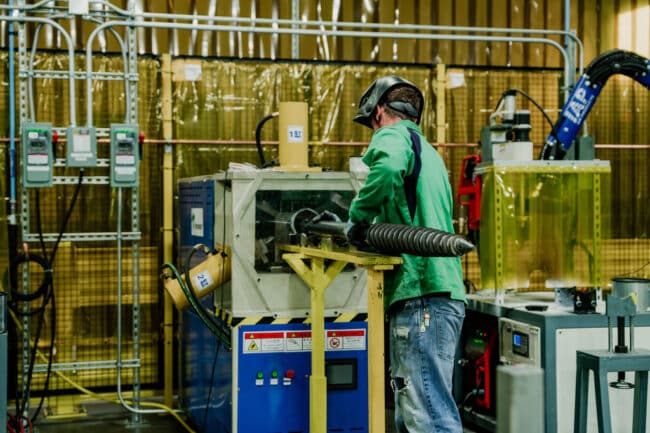


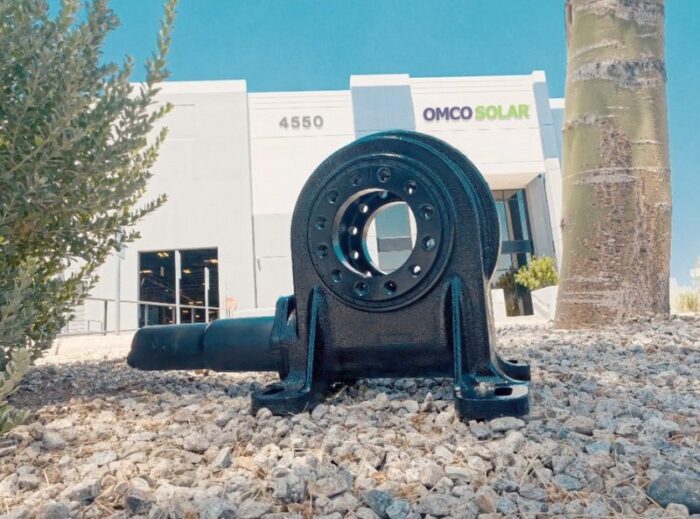

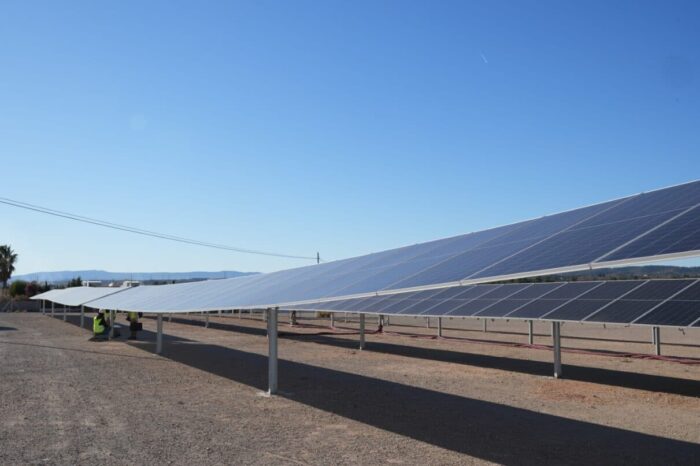

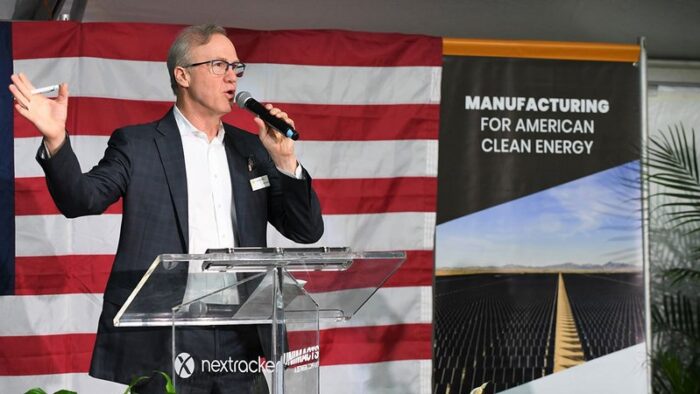



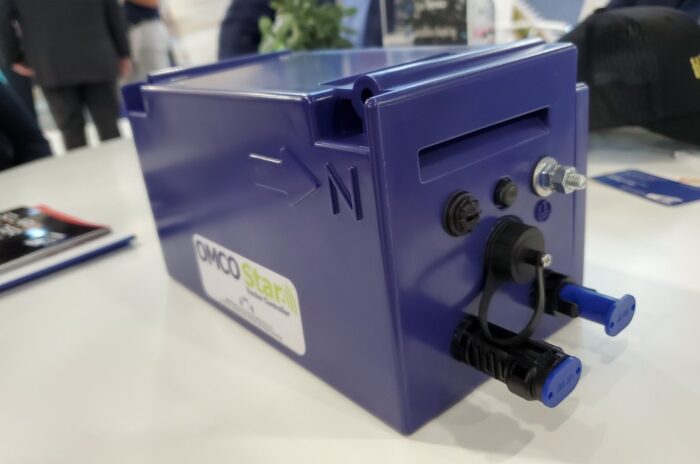
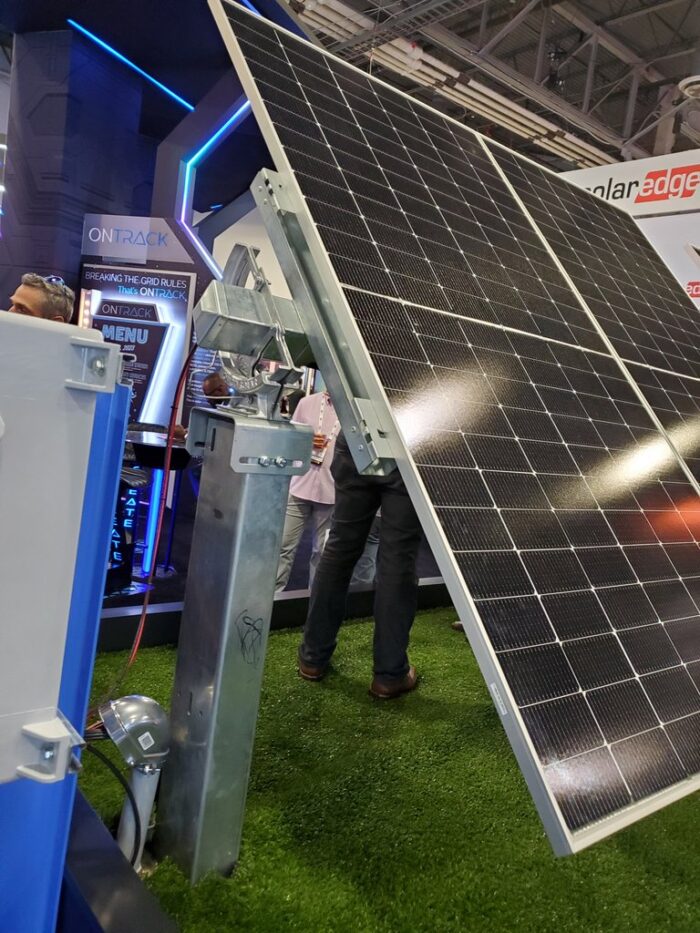
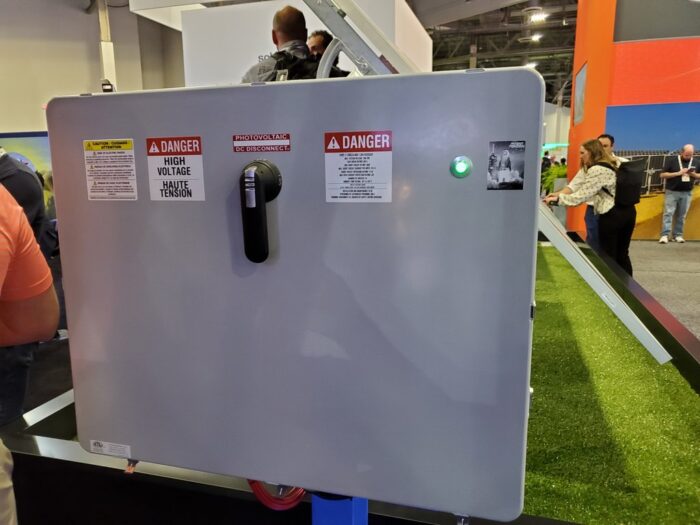
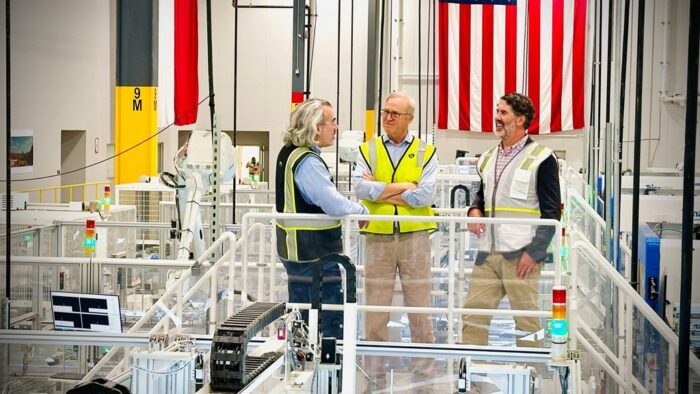
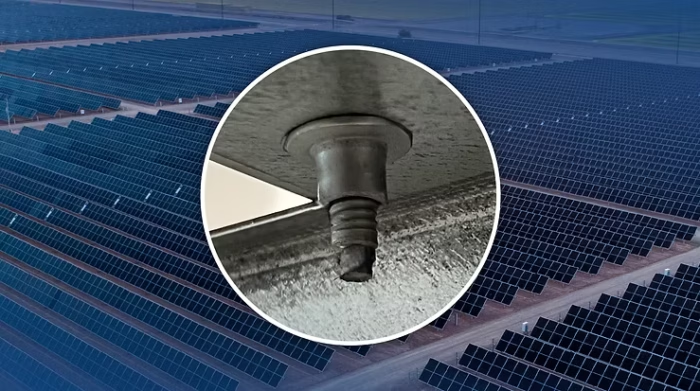
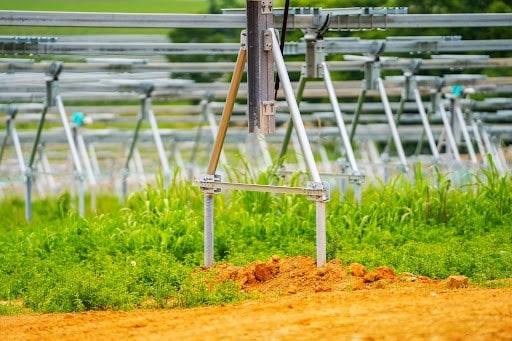

 , ensuring consistent tooling across systems. The new 003251W screw is fully backward compatible and may be used interchangeably with the previous 003250W in existing designs. Unirac’s span charts and design tools will transition to the new screw over the coming months, with many applications benefiting from improved spans.”